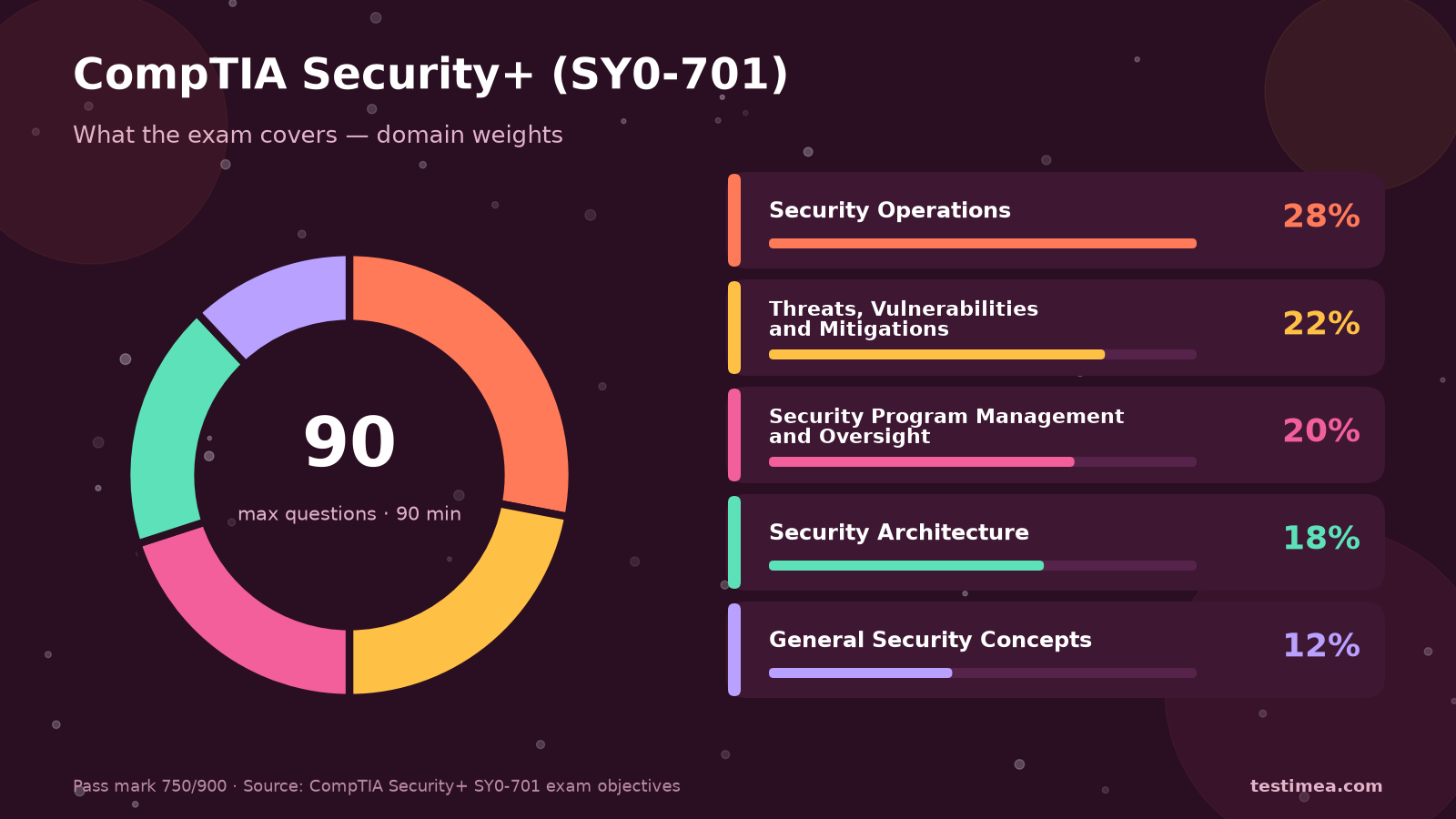
CompTIA Security+ Exam Preparation: A Practical Guide to SY0-701
CompTIA Security+ is still one of the most practical entry points into cybersecurity. Employers recognize it, many DoD 8140 work roles map to it, and the current exam—SY0-701 (Security+ V7)—focuses on skills you actually use: identifying threats, securing hybrid environments, and responding when something goes wrong.
This guide covers the current exam format, the five domains and their weights, a realistic study plan, common mistakes, and how to use practice exams without wasting time. Confirm details on the official CompTIA Security+ V7 page and the published exam objectives before you book.
CompTIA Security+ exam overview (SY0-701)
According to CompTIA’s published Security+ V7 details and the SY0-701 exam objectives:
- Exam code: SY0-701 (Security+ V7)
- Questions: Maximum of 90 (multiple-choice and performance-based)
- Duration: 90 minutes
- Passing score: 750 on a scale of 100–900
- Recommended experience: CompTIA Network+ and about two years in a security or systems administrator role (helpful, not a hard gate)
- Languages: English, Japanese, Portuguese, Spanish, and Thai
- English retirement: June 11, 2027 (other languages retire later—check CompTIA for updates)
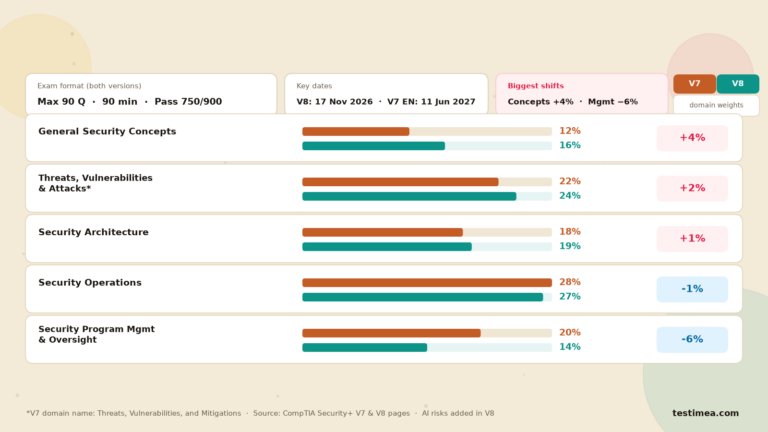
CompTIA has announced Security+ V8 (SY0-801) for around November 17, 2026. If you are preparing now, SY0-701 remains the live exam to study for until you confirm transition dates for your language and region. Voucher prices change over time—confirm the current US (or local) retail price on CompTIA’s store when you buy; recent 2026 listings after CompTIA’s mid-year adjustment commonly show around USD 439 for a standard single-attempt voucher.
The five SY0-701 domains (and how to weight your study)
Official domain weights from the CompTIA Security+ SY0-701 exam objectives:
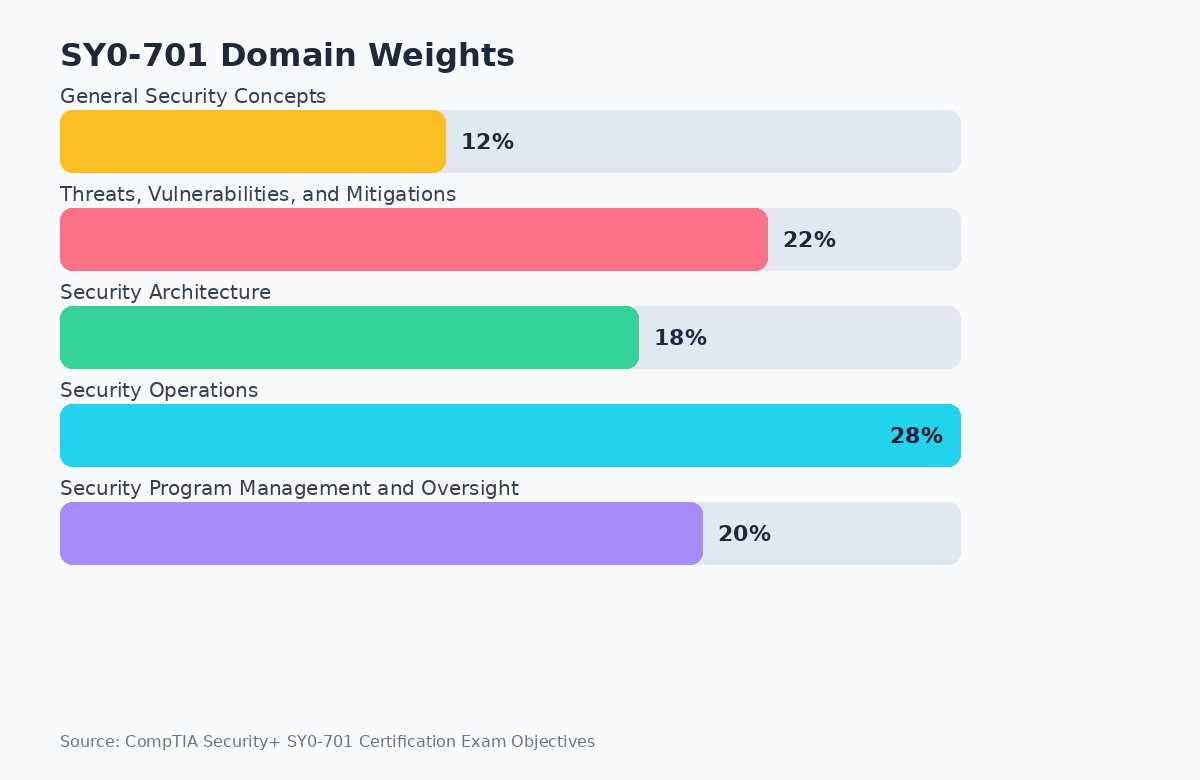
1.0 General Security Concepts (12%)
CIA triad, AAA, types of security controls, change management basics, and cryptographic building blocks (hashing, encryption, PKI, digital signatures). Smallest domain by weight—still a foundation everything else rests on.
2.0 Threats, Vulnerabilities, and Mitigations (22%)
Threat actors and motivations, attack surfaces, vulnerability types (app, cloud, supply chain, OS, and more), malicious activity patterns, and mitigations such as segmentation, hardening, and patching. Expect scenario questions that ask you to pick the best first response.
3.0 Security Architecture (18%)
On-premises vs cloud vs hybrid, IoT/ICS considerations, secure communication and access, data protection and classification, and resilience (HA, backups, site strategy). Think “design choices,” not deep vendor CLI.
4.0 Security Operations (28%)
The largest domain. Hardening and monitoring, vulnerability management, firewalls/IDS/IPS/DLP/NAC/EDR, identity (MFA, SSO, privileged access), automation concepts, incident response, and using logs in investigations. If your practice scores are weak here, this is where to spend evenings.
5.0 Security Program Management and Oversight (20%)
Governance (policies, standards, procedures), risk management, third-party risk, compliance and privacy, audits/assessments/pen testing, and security awareness. Many beginners under-study this domain and lose easy points on process questions.
A practical 4–8 week study plan
CompTIA often suggests dozens of study hours; real schedules vary. Career switchers with Network+ (or solid networking basics) often need four to six weeks. Absolute beginners may need eight. Use practice scores, not calendar optimism, as your go/no-go signal.
Weeks 1–2: Map the exam and build vocabulary
- Download the official SY0-701 objectives and highlight every acronym you cannot explain in one sentence.
- Work through a structured course or textbook aligned to V7 (not leftover SY0-601 material).
- Create a one-page sheet for control types, CIA/AAA, and crypto fundamentals.
- Take a short diagnostic quiz to find weak domains early.
Weeks 3–4: Threats + architecture depth
- Drill Domain 2 with attack → weakness → mitigation chains.
- For Domain 3, practice “which architecture fits this requirement?” scenarios (cloud vs on-prem, backup strategies, secure protocols).
- Start untimed practice questions with full explanations; rewrite misses in your own words.
Weeks 5–6: Security operations and governance
- Treat Domain 4 as your main lift: IR steps, monitoring tools, IAM, vulnerability lifecycle.
- Block dedicated time for Domain 5 risk and governance—policy questions are common.
- Begin performance-based question (PBQ) practice: matching, fill-in, and multi-step lab-style items. Do PBQs first on exam day while you are fresh.
Final 1–2 weeks: Timed mocks
- Sit two or three full timed exams (90 minutes, no notes).
- Target consistent scores comfortably above 750 before you schedule.
- Review by objective, not by “I got this one wrong.” CompTIA score reports highlight objectives—practice the same way.
Short on time? Compress weeks 1–4 into two weeks only if you already work in IT. Never skip timed mocks or PBQ practice.
Practical tips for Security+ exam day
- Read the full stem. PBQs and multi-select items punish skimming.
- Eliminate absolute answers (“always,” “never”) unless the question truly demands them.
- Pick the best CompTIA answer, which is often the most complete security control, not the cheapest shortcut.
- Flag and return. With up to 90 items in 90 minutes, you cannot afford to spiral on one PBQ.
- Know IR and risk vocab cold—containment vs eradication, qualitative vs quantitative risk, and RTO/RPO style ideas show up often.
- For general pacing habits across certs, see our exam preparation tips. If you are also building cloud fundamentals, our AWS Cloud Practitioner preparation guide pairs well as a complementary path.
Common mistakes that cost points
- Studying SY0-601 content. Domains and emphasis changed for 701—use V7-aligned materials.
- Ignoring Domain 5. Twenty percent is not optional fluff.
- Memorizing port numbers only. Useful, but Security+ rewards understanding controls and process over trivia dumps.
- Skipping PBQs in practice. They are different from multiple choice; surprise is expensive.
- Brain dumps. CompTIA prohibits unauthorized materials and can revoke certifications. Learn the objectives instead.
How practice exams help for Security+
Reading builds recognition; practice builds judgment under time pressure. Useful practice should include both Exam mode (timed, scored, explanations after submit, flagging and notes) and Practice mode (untimed feedback, retries on weak domains). That combination mirrors how people actually improve on SY0-701: learn, test, remediate, retest.
On Testimea, you can try the CompTIA Security+ free trial first, then unlock the full Security+ practice exam. One-time purchase keeps the exam on your account. For a quick format check across topics, start with the free sample exam.
FAQ
Is Security+ beginner-friendly?
It is an intermediate cybersecurity baseline. Motivated beginners pass it, but Network+ knowledge (or equivalent networking experience) makes the climb much smoother.
How long is the certification valid?
CompTIA certifications typically run on a three-year renewal cycle via continuing education or by earning a higher-level qualifying cert. Confirm current CE rules in your CompTIA account.
Should I wait for Security+ V8?
If you need the cert for a job or clearance mapping soon, take SY0-701 while it is live. If your timeline stretches past the V8 launch and English retirement window, watch CompTIA’s transition guidance before you buy training.
Are performance-based questions hard?
They feel harder if you only practice multiple choice. Treat them as applied checklists: identify the goal, apply the control, verify the result.
Start your CompTIA Security+ exam preparation
Pull the official objectives, build a domain-weighted study calendar, and mix conceptual learning with timed practice—especially Domain 4 and PBQs. When you are ready to rehearse under exam pressure, try the Security+ free trial on Testimea or go straight to the full practice exam. Steady remediation beats last-minute cramming.