GH-600 Exam Guide: GitHub Certified Agentic AI Developer (Domains, Skills, How to Prepare)
Exam GH-600, titled Developing in Agentic AI Systems on the official study guide, is the exam for the GitHub Certified: Agentic AI Developer credential. It tests whether you can operate, supervise, and govern AI agents across the software development lifecycle on GitHub. That includes MCP servers, agent memory and state, evaluating outputs, multi-agent collaboration, and guardrails. This guide covers the official domains, the exam format, and a short plan to prepare.
Read more
Exam format
These details come from the official GitHub certification page and the Microsoft Learn study guide:
- Duration: 120 minutes
- Language: English only
- Delivery: Pearson VUE, at a testing center or online
- Level: Intermediate
- Prerequisites: none formally required
- Passing score: 700 or greater
- Certificate validity: 12 months
GitHub still recommends a solid background before you book. You should be comfortable with the software development lifecycle, GitHub workflows and controls, and normal code quality and review practice. You should also have used coding agents, including GitHub Copilot, MCP servers, custom instructions, custom agents, tools, and Copilot setup steps. Typical candidates include architects, platform engineers, DevOps engineers, application developers, product managers, and security engineers.
Most questions cover generally available features, though commonly used preview features can appear.
The six domains
Weights are from the official GH-600 study guide:
| Domain | Weight |
|---|---|
| Prepare agent architecture and SDLC processes | 15-20% |
| Implement tool use and environment interaction | 20-25% |
| Manage memory, state, and execution | 10-15% |
| Perform evaluation, error analysis, and tuning | 15-20% |
| Orchestrate multi-agent coordination | 15-20% |
| Implement guardrails and accountability | 10-15% |
Prepare agent architecture and SDLC processes (15-20%). Decide where agents belong in the delivery process, set inputs, outputs, and success criteria, and keep planning separate from execution. You should be able to make agent work inspectable and add human checks without slowing the team down.
Implement tool use and environment interaction (20-25%). This is the largest slice. It covers choosing tools and permissions, adding MCP servers (including a GitHub remote MCP server, registries, and allow lists), and scoping an agent to a repository, a branch, or a CI workflow. It also covers safe execution: retries, rollbacks, escalation, and a clear record of what the agent did.
Manage memory, state, and execution (10-15%). Choose between short-term, long-term, and external memory, keep only what the task needs, and persist progress so an agent can resume without repeating itself or drifting off course. You also need to share state across tools without stale or conflicting context.
Perform evaluation, error analysis, and tuning (15-20%). Define what good looks like, use logs, plans, traces, and scan results to find failures, and then adjust instructions, memory, or tool access. Typical root causes include reasoning errors, tool misuse, and problems in the context or environment.
Orchestrate multi-agent coordination (15-20%). Run more than one agent, isolate parallel work, and resolve conflicts such as overlapping code changes or contradictory outputs. You should also recover from stalled or partial runs, and be able to add, replace, or retire an agent without breaking the workflow.
Implement guardrails and accountability (10-15%). Set autonomy levels by operational, security, and compliance risk. Block actions that break policy, keep permissions tight, and require a human for irreversible or sensitive changes, without adding approvals that do not actually reduce risk.
How to prepare
- Start with the official material. Read the GH-600 study guide end to end, then use the related Microsoft Learn course, GH-600T00-A: Developing in Agentic AI Systems. The study guide also points to self-paced modules on foundations of agentic AI in GitHub, agent architecture and SDLC integration, and tooling, MCP, and execution environments.
- Practise in a real repository. Add an MCP server, set an allow list, scope an agent to a repo or a branch, and let it open a pull request. Then add a second agent and watch for conflicting changes.
- Keep artifacts and judge the output. Save plans, logs, and scan results. Practise deciding whether the agent met the success criteria, explaining why it failed, and tightening instructions or tool access.
- Work through the guardrails. Decide which actions need a human, which permissions are too broad, and how to stop a risky change without reviewing every small step.
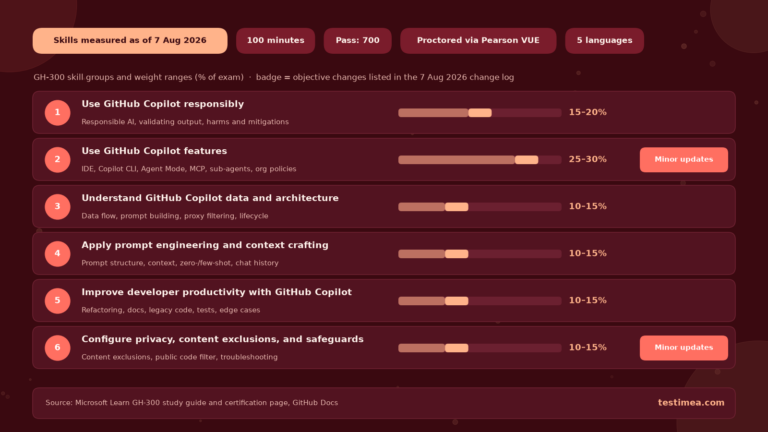
We do not have a GH-600 practice exam yet, but one is coming. Until then, the closest practice on testimea is our GitHub Copilot (GH-300) practice exam. Use it for the overlapping parts: Copilot, MCP servers, and custom agents. It will not cover the full GH-600 syllabus, especially multi-agent orchestration, memory and state, evaluation, and guardrails.
Sources
- GitHub Agentic AI Developer certification page: duration, language, Pearson VUE delivery, 12-month validity, prerequisites, and domain outline
- Microsoft Learn certification page: credential name, audience, duration, English-language delivery, and domain weights
- GH-600 study guide: skills measured, domain weights, passing score, and study resources
- Course GH-600T00-A: Developing in Agentic AI Systems: official training aligned to the certification
Exam details change. Recheck the official pages before you book.